
Emotional Intelligence has a significant, positive and substantial correlation with Self-leadership as described in the IFS model, in a team sport context
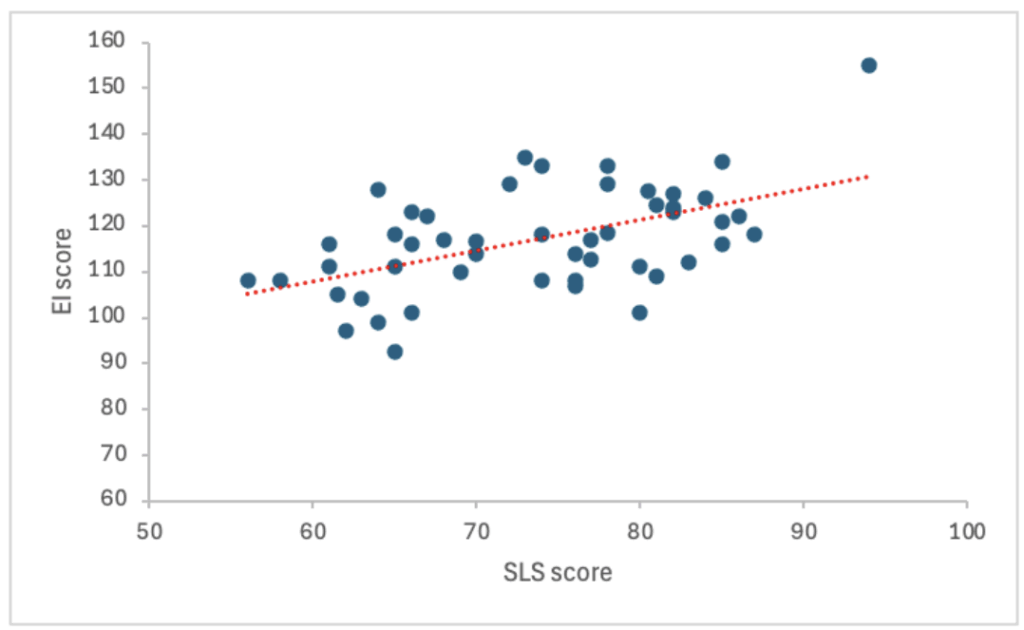
Figure 1. A scatterplot of Emotional Intelligence Scores (EI) and Self-Leadership Scores (SLS) shows a positive correlation, with one outlier.
Here’s a dirty little secret of mine. I think academic research articles are brutally boring, difficult to read, and the information in them, however good and important, is hard to digest. I think the micro focus of especially a quantitative study (those that gather numerical statistics) can often leave out plenty of pertinent peripheral information. I have this opinion because I have both read A LOT of research and have conducted research. The most recent research study I conducted sought to determine whether Emotional Intelligence scores and Self-Leadership scores (being Self-Led in the Internal Family Systems-IFS- model) correlate. I conducted this research with University level Varsity Rugby Teams to inform and test my theory that using the principles of IFS to enhance Emotional Intelligence was a valid approach to increase Emotional Intelligence in team sport athletes. The results of the research confirmed that it is most certainly a worthy approach.
Being “Self-led” in the IFS model means that a person allows their True Self direct actions…I like to say that a person has their True Self at their inner control panel…meaning at least some of the characteristics of True Self, confidence, compassion, curiosity, clarity, courage, creativity, calm/composure and connectedness, guide their thoughts and actions. Emotional Intelligence (EI) was defined as “the ability to monitor one’s own and others’ feelings and emotions, to discriminate amongst them, and to use this information to guide one’s thinking and actions.” (Salovey & Mayer, 1990). EI includes the recognition and use of one’s own and others’ emotional states to solve problems and regulate behavior. Meaning a person needs to have awareness of an emotion, understand what reaction that emotion elicits and why it is happening, then use that information to develop responses that facilitate optimal outcomes and performances.
It is not generally surprising, given the amount of research which indicates that emotions and sports go hand in hand, that Emotional Intelligence has a significant, positive and substantial correlation with Self-leadership as described in the IFS model, in a team sport context. But instead of going into my research, I am going to offer you an anecdote to illustrate what I mean. This past weekend I participated in a two-day bike event. The first day was a 64-mile (100k) gravel bike ride which included not only gravel roads, but snowmobile trails, power line roads, and multi-use nordic trails. It took me 7 hours and 44 minutes. That’s slow. The second day was a 50-mile (ended up being 50.9 mile) mountain bike ride on mostly single track, but also up a ski slope and through some farm fields, and a bit of gravel road to connect it all together. Day 2 took me 9 hours and 13 minutes. That’s even slower! I want to tell you about my experience on the second day. It was about mile 28 and I had just come out of some single track and into the parking lot at the base lodge of the ski area when a guy riding near me was expressing how fatigued he was. I let him know I was also tired, that we have a climb to the next feed station and we could decide at that point if we wanted to bail, because I knew the way back to the venue by gravel road. This is an example of common humanity…a connectedness people experience while facing the same challenge or struggle. We rode together up the ski trail, both of us walking a portion of because of its steep elevation and our weariness, but we made it. I drank pickle juice and suggested he try it, which he did. We ate some carbs and refilled our water bottles. I said we could head back here, but he decided to keep going…so I followed behind him. Examples of courage and confidence for both of us. On the way up the next climb he asked how I trained for this event, because he thought he trained plenty, but was humbled by how difficult the ride was. Curiosity! I told him some of my training regime and how I had completed a 6-day gravel ride (VTXL) the month before, so I knew I would be able to complete both days of this event. He said “wait, you rode yesterday? 100k?!” I said, yeah. He said that I inspired him, and he thought the pickle juice helped. At the next road crossing I decided I had enough…I headed down to the gravel road to go back to the venue, but not before handing him my headlamp, which I had brought anticipating I may not finish before dark. He gladly accepted it. Examples of compassion, connection, and clarity. He headed into a short but technical section of single track. Less than a mile down the gravel road I saw him coming up the gravel road and he called to me “Jill!..wanna ride with me?!” So I bailed on bailing!…covered the same mileage, albeit not in the woods, and turned around and joined him to continue on the ride. His offer of connection, of experiencing the same challenge and his composure and confidence mirrored onto me, and allowed me to re-engage, and make a decision which led to a more optimal performance and outcome on my part. To be clear, he was inspired when I was Self-led, and in turn he allowed courage and confidence to guide his actions to stay persistent in finishing the course. His offer of connection then encouraged me to be led by my own courage, confidence and clarity to also complete the course. I became aware of his emotions, his enthusiasm in the face of difficulty, and was happy to continue the ride with him. He instilled enthusiasm in me! We inspired each other without even knowing it! It was an example of emotional intelligence to realize I did not need to bail, with the help of a Self-led stranger who happened to be experiencing the same challenge as me. We both finished. Me out of the woods just before dark but back to the venue when it was just dark, and he with the headlamp on not long after! To me, this is a living example how increasing EI by using the principles of IFS (being Self-led) works to enhance physical performance, emotional wellbeing and positive and optimal outcomes. We saw each other demonstrating the characteristics of True Self, became aware of them and the emotions that may have constrained performance (me bailing, then UN-bailing) and making a choice to endure, stay connected, responding to emotions in a way that led to enhanced performance at a task.
Back to the research. My study shows that using the principles of Internal Family Systems (IFS), which promotes Self-Leadership, is an effective way to impart and train ability Emotional Intelligence in a sport/athletic context, at least for the team sport of Rugby! I had the opportunity to conduct research in the 2024-2025 Rugby Season. The results of this study support using IFS principles to train or coach EI skills in a sport/athletic context. When all of the characteristics of Self-Leadership (Confidence, Clarity, Connectedness, Calm/Composure, Curiosity, Compassion, Courage and Creativity) were looked at together there was a significant correlation. I believe that the characteristics (8 C’s) of Self-Leadership are interconnected and are interdependent, meaning the presence of each C in turn makes the other C’s shine through as well. When broken down into the individual C’s of Self-leadership Clarity was most strongly significant. Could this indicate that Clarity, the ability to know what needs to be done in any given situation, might be the most prevalent or universal characteristic of Self-leadership? Clarity being an overall awareness.
Using statistics gathered for the purpose of improving EI sessions to the teams to identify the strongest characteristics of Self called on to play Rugby, Courage, Confidence and Calm/Composure were the next of the individual Self-leadership C’s to become significant with rugby athletes.
Components of Self-leadership often overlap with components of Emotional Intelligence. The benefit of developing and enhancing Self-leadership as described in the IFS model, both as supported by my study, as well as in my personal experience, enhances Emotional Intelligence in a sport and athletic context.
It is my hope and recommendation that sport teams, coaches and sporting organizations consider providing their teams and athletes with Emotional Intelligence coaching using the principles of Internal Family Systems, as previous research has shown that increasing emotional intelligence enhances athletic performance, team cohesion and application of mental skills.